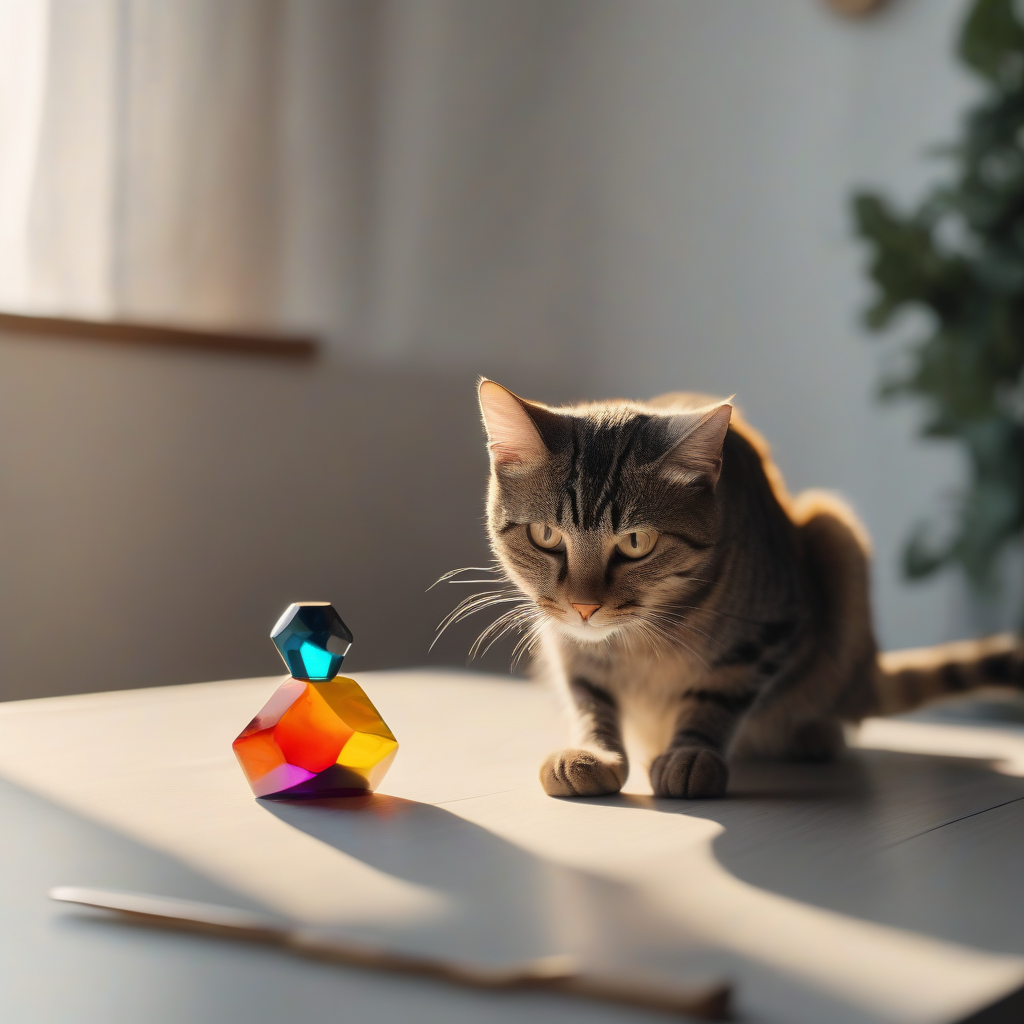
March 2026's Viral Discovery: Your Cat's Secret Scientist Instinct! 7 Smart Secrets Revealing How They Observe and Interpret Every Experiment at Home!
Welcome to one of March 2026's most captivating discoveries: Your cats aren't just adorable companions, but also tiny scientists ceaselessly collecting data, formulating hypotheses, and conducting experiments within the four walls of your home! At YuDo Pet, we know that our furry friends possess a far deeper mental life than we often realize, and this spring, we invite you to understand their astonishing instinct. Have you ever wondered how your cat tries to decipher the "why" behind your every move, every sound, and every object? Get ready, because in this article, we'll uncover your cat's secret scientific abilities and how they operate in their home laboratory.
The Scientific Foundations of Your Furry Friend's Observational Skills
Cats are inherently curious and analytical creatures. Their predatory instincts lead them to constantly scan their environment and notice even the slightest change. This sharp sense and focused attention transform them from passive observers into active "researchers." They evaluate every stimulus in their environment as a potential piece of information, storing these insights in an internal database.
Observation and Learning: How Cats Collect Data
Cats actively experience the world through their five senses. They don't just see; they smell, hear, touch, and even taste to gain information. Your daily routines, changes in your tone of voice, the placement of objects, or even the outdoor weather are all sources of data for them. They process this data in their minds, identify patterns, and use them to predict future events. This is a natural learning process, far beyond simple "training"; it's as if they are constantly learning a new lesson.
Hypotheses and Experiments: The Logic Within a Cat's Inner World
This process isn't limited to passive data collection. Just like a scientist, cats form hypotheses based on their observations and conduct small "experiments" to test these hypotheses. For example, they might be curious about the sound produced when they knock over a specific object or what your reaction will be. This isn't just a simple game or mischief; it's an intrinsic drive to understand the outcomes of environmental interactions. These "experiments" enable them to comprehend and adapt to their world, almost like drafting their own small scientific reports.
7 Smart Secrets Unveiling Your Cat's Secret Scientist Instinct
Are you ready to discover the scientific curiosity underlying your cat's everyday behaviors? Here are 7 smart secrets that reveal your furry friend's hidden scientist potential:
1. Mapping Your Routine: The Expert of Time and Space
Cats follow your daily schedule with incredible precision. Your morning wake-up time, meal times, your departure and return from work... all these form a timeline in their minds. A delay or change in a ritual becomes an "anomaly" that captures their attention. Their waiting by the door before you even get there, or circling around you as mealtime approaches, are results of these "routine mapping" skills. Your every move can be a clue to the next event in their eyes.
2. Cause-and-Effect Experiments: In Pursuit of Consequence
Entering when you open the door, gauging your reaction when they drop an object, or joining you when you get into bed... these behaviors aren't just simple habits, but ways of testing the impact of your actions on them. They seek answers to questions like, "What happens with this sound?" or "What do I gain if I do this movement?" In short, they are constantly trying to solve your behavioral equation.
3. Environmental Change Analyses: Deciphering the New
Pay attention to the detailed scrutiny your cat displays when new furniture arrives, an old item's place changes, or even when you simply bring in a new plant. Behaviors like sniffing, scratching, or circling are "research" processes aimed at understanding what the object is, its potential dangers, or its benefits. Every newly added or relocated object is a new "hypothesis" and "experiment" for them.
4. Human Emotion Reader: Social Intelligence and Empathy Tests
Cats can surprisingly well read your mood from your tone of voice, body language, and facial expressions. Their coming to your side when you're sad, keeping a distance when you're stressed, or inviting you to play when you're happy, demonstrates that they observe your emotional responses and adjust their own behavior accordingly. This is their "expertise" in the field of social sciences; they are constantly measuring your emotional "atmosphere."
5. Gravity and Physics Law Tests: Why Do Things Fall?
When cats push objects off high places with their paws or try to balance on a scratching post, it shouldn't be interpreted merely as mischief. They are testing the dynamics of objects falling, the effect of gravity, and their own balance capabilities. These are small-scale physics experiments; they collect "data" such as object mass, angle of fall, and sound reaction, trying to understand how things work. Each fall is a new learning opportunity for them.
6. Sound and Frequency Research: Exploring the Acoustic World
The doorbell, telephone ring, bird sounds from outside, or your specific words... Cats analyze the meaning behind each of these sounds and their frequency. Their varied responses to different sounds indicate that they categorize them and assign specific meanings. Perhaps one day they'll create their own "meow-dictionary" and communicate with you in a more scientific manner!
7. Social Observation and Imitation: Adaptation Through Learning
Cats carefully observe other animals in the household (if any) and even humans. They might try to observe and imitate how water is drunk, how a door is opened, or how to interact with a specific toy. This is a powerful example of social learning and demonstrates how developed their adaptive abilities are. They validate their own "hypotheses" by watching your "experiments."
Ways to Support Your Furry Scientist
Supporting your cat's natural scientific curiosity is crucial for their mental health and overall happiness. Providing them with an appropriate learning and exploration environment will nurture the scientist within them.
Enhance Mental Stimulation: Puzzle Toys and Interaction
Puzzle toys, treat-dispensing games, or interactive toys encourage your cat's problem-solving skills and analytical thinking. Satisfy their desire to "experiment" and see the results. Keep them engaged with new games and challenges.
Provide Safe Experimentation Areas: Freedom for New Discoveries
Create safe and explorable areas in your home. New scents, different textures, or high climbing spaces help them develop their environmental analysis skills. Of course, ensure these areas pose no danger to them and provide supervised exploration opportunities.
Respect Their Observations: Understanding and Encouraging Their Curiosity
Don't view your cat observing you or an object for a long time as an inconvenience. This is their learning process. Allow them to observe calmly, and sometimes reward their curiosity with small interactions. Respecting their mental processes will strengthen the bond between you.
Conclusion
In March 2026, your perspective on your cat is changing! You now know they are not just a purring companion on your lap, but also a little scientist conducting secret experiments in every corner of your home, trying to understand the universe from their own perspective. Exploring your cat's astonishing mental world will deepen your bond with them and make every moment at home more meaningful. Remember, at YuDo Pet, we're always here to help your furry friends live their best lives and support you in uncovering their hidden talents!